


Scarcity is a word thrown around a lot and it’s rarely defined. It’s usually used to describe our relationship with money but it’s far more expansive than that. Scarcity is a fear-based limiting belief of our worthiness. It’s no mistake that how we quantify our worthiness is also an economic term.
There’s an oscillation in scarcity between obsession and deprivation, from being “too much” to “not enough”. Regardless of the measurement, we are found lacking. And that’s how imposter syndrome amplifies scarcity - the fear of being found out makes us work extra hard to maintain a persona of “having it together”.
Scarcity is actually about love when we’ve been peddled cheap reproductions of love and impacts our relationships more than anything. We want to intervene in scarcity in the realm of money because it’s more tangible than love. All expressions of scarcity need to be addressed at the same time, because they’re all important.
Emotional Scarcity: feeling overwhelmed by your feelings, disconnected and judgemental of having feelings, your feelings are “too much” and shouldn’t make “emotional” decisions
Relational Scarcity: feeling suspicious of your partners’ love without evidence, questioning whether their love has strings attached, too good to be true
Time Scarcity: feeling like time is running out, overly busy, overworked, putting off for time off sometime in the distant future
We keep ourselves from the life we want because it is easier and safer to live in fantasy. In fantasy, there is no risk. Living in fantasy, of the life we think we want, holding our dream like a carrot on a string, drain our energy. Then we don’t have the capacity to pursue the life we want and can instead imagine what “could” be. If we were to bring our dreams into reality, we are afraid of having to sustain it because it is meaningful. That shows value - we don’t want to mess it up! It’s just that in fantasy, the dream isn’t real and your dreams deserve to be real. This is how our limiting beliefs of worthiness that we’d inherently “ruin” our dream impacts our reality. Our ideal life isn’t that far away.
When we talk about scarcity, it is always grounded in reality. The reality that systems of oppression create & maintain scarcity in pursuit of profit.In spiritual circles, money is reduced to an energy without holding the very present reality of inequity in wealth access. Will my landlord take “energy” for my rent? We are fed lies of economic mobility without the context of generational wealth or wealth hoarding from exploitation of marginalized groups. We cannot dissect scarcity from our own psyche without acknowledging, unlearning & dismantling the exploitation of systems of oppression.
Scarcity is often reduced to money and it definitely shows up in our relationship to money but scarcity also shows up in how we relate to food, how we learn to (dis)trust love. In a capitalistic culture, money does hold power - whether we like it or not. When we are afraid of our own power (or of wielding power well instead of wielding power over), we distance our Selves from markers of power out of fear.
When we are addressing our relationship to scarcity, we are actually addressing our relationship to power. And it is a relationship - relationships require intention, effort, dialogue. Closing your eyes while opening your bank app is not relational. We are more beholden to scarcity than we think because we are beholden by fear.
In a world driven by profit, even abundance feels limited. Shelves overflow, yet adverts whisper that what you have is never enough. Everyone competes for the same resources, the same attention, the same status, and the system thrives on that tension. Scarcity is manufactured. There are enough resources in the world for everyone, but the distribution is skewed. It’s this contrived pressure that shapes choices, fuels anxiety, and makes generosity costly. People hoard, compare, and rush, believing there’s never quite enough to go around. And in that hurry, the richness of life, the creativity, connection, and care is often what slips through our fingers, lost to the logic of scarcity.
We’re taught to measure success in accumulation, in the constant chase for more. More money, more stuff, more recognition. Capitalism convinces us that there’s a finite amount of resources and rewards, so we guard what we have and covet what we don’t. Even the air we breathe, the food we eat, the time we spend, everything becomes a commodity. Scarcity becomes a lens through which we view life, turning abundance into competition, generosity into risk, and collaboration into compromise. And yet, the irony is clear: the system that tells us there isn’t enough also produces more than we could ever need if only we could step outside its rules.
Consumerism pulls on the strings of attachment, waving our existential needs right under our nose. Phrases like “Our Special Price” or “Exclusive Discount” or “Members Price” create a sense of belonging, of acceptance. And for a moment, it works. We feel included and the rush of dopamine satiates any inner discomfort. While we’re in the store at least. As soon as we get the purchase home, we feel the same emptiness as we do after we get home from a party where we had fun but were performing a persona the entire time. Inner discomfort cannot be satiated with external salve - inner discomfort requires us to turn toward our true Selves.
The things we impulsively buy can be fulfilling unmet attachment needs (buying different decor for the house is often connected to people pleasing a maternal figure) or create a sense of control in an otherwise powerless world. Either way, consumerism creates a sense of safety.
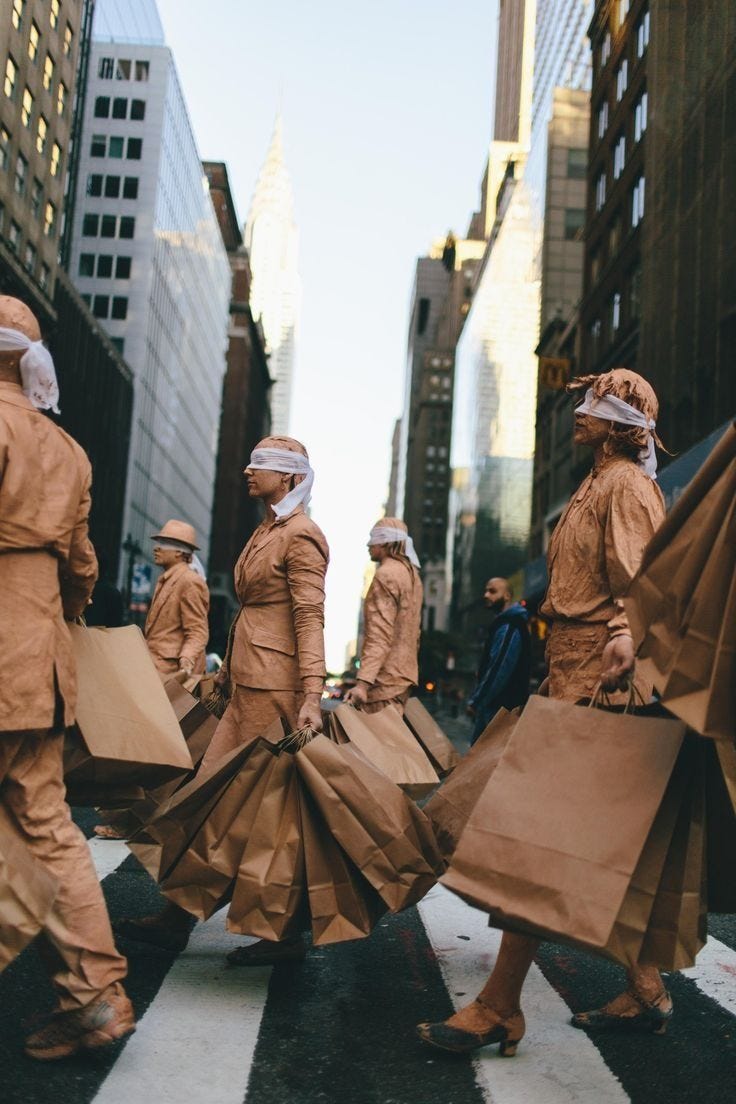
Scarcity works as a tool of control because most of us were raised with conditional love, where we had to earn love and when we had love, it could be taken away if we weren’t “good”. Consumerism works the same way - you must earn your acceptance by following the rules of trend and if you aren’t contributing to the economy by getting into debt, you are unpatriotic. We experience love as a finite resource, something to be rationed and tucked away - not the immersive, infinite experience of limitless beauty that love truly is.
Scarcity is experienced as a primordial insufficiency, the feeling something is “wrong” with you but with no idea what. FOMO, the fear of missing out, is centre to the experience of scarcity. The fear of missing out is nothing more than an existential fear of non-existence - that without the externalized perception of attendance, without the confirmation of the amorphous Other, we are Not. Scarcity means we are “making it work” and “taking what we can get” that’s “close enough” because these are knowable frameworks.
In contrast, we are ironically afraid of our authenticity because there is no pre-existing framework because the very purpose of authenticity is that it is unrepeatable - because there is no schema, it is unfamiliar therefore unknown and coded in our brain as unsafe (not because it is but because it is unfamiliar). We both fear and desire our authenticity and externalize control and blame instead of recognizing how we hold ourselves hostage to expectations - both our own and projected expectations. These expectations inevitably lead to disappointment because people are just human and messy and our fantasy never happens the way we anticipate in reality.
It is expectations that create a need to be in control in order to fulfill the never-ending demands of the persona imago (to fill the empty space). Life’s constant reminders that we are out of control, we are a continual threat of exposing our true insufficiency so we overcompensate with a suffocating grasp to maintain the illusion of certainty / safety. We feed the possession of persona for the false promise of perfection - an infallible love, an oxymoron that negates the reality of true love. We are attached to our expectations as an operating scheme in our quest for certainty.

We can see examples of scarcity in our collective fear of endings:
when a friendship has naturally come to a close
when it’s time to leave a job
Instead of listening to how our body’s communicate completion, we “make it work” long asfter the expiry date because we are terrified we’ll never find something else. But there is a cosmic exchange that must happen. We must say no before we can say yes. There is of course limitations to this but it about trusting the universe, and trusting ourselves (the macro and the micro of the same, respectively). To have space for the expansive life we want, we have to make room. We have to say no to what isn’t for us. And just because something ends, doesn’t mean it wasn’t meaningful. Things can end and they can still be meaningful.
We play into consumerism even if our highest morals beg us not to because there are entire systems that are triggering our attachment wounds, our dopamine reward centres and our worst fears of scarcity are being confirmed everyday in commercials (“limited time offer”).
Consumerism works because we have a cultural intolerance to space, but we need space. We need to let a cake rest before cutting it. We need to let pottery sit before firing it. The compulsivity to fill our lives - to spend beyond our means, to purge & donate car loads twice a year, only to fill the space with the next load of what-you’re-supposed-to-desire - keeps us chasing a dragon. We are seeking inner peace from external acquisition. It won’t happen. Our intolerance has us chained to a hedonic treadmill, constantly chasing happiness from a new boat, or a new car, or new clothes - but we’re on a treadmill. We’re going nowhere.
And also - we cannot attack the system without acknowledging the need the system is meeting, the purpose it is serving. Consumerism has taken the place of our attachment needs as we have become increasingly individualistic post industrial revolution. Leaving behind our collectivist roots has not severed the deeply rooted need of attachment. Consumerism has promised we will both give and receive love through this third party of gifts. We have it all backwards. We experience the earths’ resource as being infinite (even though we learn in the third grade about non-renewable resources, it’s literally in the name) and we experience love as a finite resource.
It is love that is infinite - and not a measly, carrot-on-a-string love - but a heart cracking open kind of love. That kind of love isn’t going anywhere. That kind of love cannot be bought from a store.
They had unconsciously agreed to the rules of engagement that their power would be constrained by the patriarchy. And some of them occupied the roles considered “acceptable” within this system, yet even that offered only limited access.
Paths to influence were measured by usefulness, conformity, and proximity to those already holding power. This formula for navigating the system became the root of scarcity. Others were experienced as competition for finite resources. Distrust and resentment grew because the system encouraged it, and survival often demanded compromise.
Many were caught in the throes of Stockholm syndrome with a system bent on their limitation. Complicity in systemic oppression became inevitable when one cannot see beyond the lens of the structure itself. The patriarchy doesn’t need to enforce its standards externally, because its script is internalized. People police themselves and each other, the ultimate panopticon.
As people challenge the rules of the patriarchy, they are chastised for stepping outside expectations. As individuals unlearn binary frameworks of identity and power, they are demeaned for simply being themselves. Freedom is a threat to a system built on fear-based control.
The patriarchy peddles cheap reproductions of freedom, and society “makes it work” because alternative ways are hidden or unrecognized. Many are indoctrinated to believe it is either sink or swim; dominate or be dominated; possess or be possessed; exploit or be exploited.
The system is inherently objectifying because it sees nothing as fully alive. It fears the power of Aliveness.
But it is not sink or swim. Bodies and minds are naturally buoyant; one can float. There is no need to conquer the currents or be consumed by them, because life itself is Alive. It is possible to move with it, to unite with it, to be carried without losing oneself.

The patriarchy peddles power with an expiry date and pages of terms of service. Rip them to shreds. Tear off the blindfold and see. Once the eyes open, the suffocation of Life cannot be unseen. Grieve. Grieve with your siblings, your friends, your chosen family. Grieve with your trans and non-binary siblings, with those whose humanity has been minimized, erased, or commodified.
Living under these systems is often a non-choice, but being complicit in them is a choice. We are far too expansive for a structure built on limitation. By embodying natural power (a resource that arises from self-trust, curiosity, and presence) we can live life fully Alive. Toxic patterns, conditioning, and the desperate need to be “useful” or acceptable can be purged from the body and mind. These are self-fulfilling loops that serve only a system that sees nothing as fully Alive.
Relating to one’s inner strength outside of patriarchal metrics rebuilds trust in the self, allowing for joy, play, and connection unmediated by control, judgment, or commodification. Until the system is evicted from our psyches, each of us can be complicit in upholding its power.
Living outside the system requires patience, courage, and radical imagination. It’s not about abandoning responsibility or ethics, but about reconfiguring what life can look like when one refuses to adhere to artificial scarcity, domination, or hierarchical definitions of worth. To live outside the system is to recognize that time, energy, creativity, and attention are infinite when freed from the compulsions of compliance. It is to create networks of mutual respect, collaboration, and reciprocity rather than competition. It is to see systems not as immutable, but as structures that can be navigated, reshaped, or left behind.
This path invites one to honour their natural rhythms, to move with curiosity instead of fear, to develop practices that nourish rather than exploit. It is a commitment to listening to one’s body, one’s intuition, and one’s community. Outside the system, scarcity becomes a construct, not a reality. Freedom is not a gift—it is the inherent state of life that patriarchy obscures. Living here requires vigilance, yes, but also deep delight: delight in presence, delight in creation, delight in relationships unconstrained by oppressive hierarchies. To step outside is to embrace the fullness of Aliveness, to inhabit a world where the self is never a commodity, and where each choice is a reclamation of power that was always yours.
Internalized capitalism equates usefulness with worthiness. Remember that:
You are worthy as you are. You don’t have to prove your worth. You are a person. You exist. You deserve to exist. Your existence is a gift. You deserve rest. You are not the problem. You are not a problem. Your life is your own to live. You are sovereign. You are not alone. You don’t need to hold your pain alone. You are with yourself. Your body is sacred. There is nothing you have to do. You can fully inhabit yourself. Your existence is enough. You are the exact amount of you. You deserve to expand. You are important and fallible. You can trust yourself. You deserve to be protected. You are not a commodity. You are beyond your productivity .