


We invest so much time, energy, and resources into our self-hatred. We scrutinise our bodies, negotiate with our appetites, and exhaust ourselves trying to become someone we believe would be more worthy of love, belonging, and acceptance. But what might become possible if we stopped treating our bodies as problems to solve and began relating to them as living, changing parts of ourselves? What if healing our relationship with our bodies wasn’t about learning to love every inch of ourselves, but about learning to trust ourselves enough to live?
CW - body image, disordered eating
She grabbed her thighs in disgust, desperately trying to shape her reflection. After meals, they lament about how their stomach distends upon digestion (of course it does). Their worthiness is interconnected with the flatness of their stomach.
It starts young (it always does). Family start commenting on body’s developing at 8, 9, 10 years old, when the body is still becoming itself. How the adults around you respond can change how we experience our body. Do they hide the scales and teach hunger cues or do they discourage “bad” foods and sigh heavily at their own reflection?
We learn to equate our growth with being “bad”, that our expansion is a problem.
Fatphobia infiltrates every level of our society where moralism is attached to our size. It is everywhere and it is nowhere. It is in our schools, our families, our workplaces, in our heads.
We have internalized fat phobia as a culture and as individuals, we have unconsciously agreed & participated in the policing of our bodies because we desperately want to be good. To be valued.
Our attachment need can get the better of us.
And our Bodies hear how we talk about them.
Our relationship with our Bodies is just like any other relationship - it is developed with shared experience, values and dialogue. If we spoke to our partner(s), our friends, our children, in the same way we spoke to our bodies, those relationships would suffer accordingly. Our bodies suffer accordingly.

We have inherited a complicated relationship with our bodies. Across generations, cultural ideals have dictated which bodies are desirable, which are worthy of admiration, and which should be hidden, corrected, or controlled. From the devastating consequences of disordered eating to the everyday experience of feeling uncomfortable in our own skin, these ideals have long shaped our sense of self.
But perhaps the most insidious part of these standards isn’t simply that they are unrealistic. It’s that they teach us to experience our bodies as problems to be solved rather than as the places from which we experience our lives.
We learn to look at ourselves from the outside, imagining how we might appear to others. We measure, compare, critique, and negotiate with our reflections. Our bodies become projects requiring constant improvement, their worth seemingly contingent on how closely they approximate an ever-shifting ideal.
And somewhere along the way, we can lose sight of a fundamental truth: we are not bodies that need to earn the right to exist. We are human beings who happen to experience the world through them.
I don’t need to tell you how beauty standards distort our understanding of what bodies naturally look like, how images are manipulated to reinforce narrow ideals, or how cultural expectations contribute to disordered eating and body dissatisfaction. We know these standards are constructed, but knowing this doesn’t necessarily free us from their influence.
Because the relationship we have with our bodies isn’t merely intellectual. It is emotional, relational, and deeply existential. It touches our sense of belonging, our fear of rejection, our longing to be loved, and our desire to feel at home in ourselves.
We can understand that beauty standards are arbitrary and still feel inadequate when we look in the mirror. We can recognise that bodies naturally change and still grieve the body we once had. We can reject the idea that our worth is determined by our appearance and still find ourselves negotiating with the scale, the mirror, or the imagined gaze of others.
We suffer from a rejection of our natural body - who and how we naturally are. If you have to restrict your food intake to maintain your body shape / weight, that is not your natural state. Your natural state allows you to live.
This rejection asks us to deny something fundamental about what it means to be alive: that we are not static, fixed, or endlessly controllable. Our bodies are alive. We are in rejection of our Bodies as alive because our Bodies are viewed as disposable, as resources to be exploited. Your Body is Alive so your Body is always changing. Just as the earth is alive and is always changing, so too are our Bodies.
Intuitive eating & intuitive movement is a beautiful way of respecting your Body’s aliveness. Because you are a grown person and can eat as much as you want. You don’t need permission from anyone but your body. Listening to your body’s desires, listening to your body’s appetite, has beautiful impacts. We become more able to meet our needs, to listen to what we want and don’t want, to set boundaries.
There is an interesting relationship between how we restrict our food and how we restrict ourselves in other areas of life. When we struggle to honour our own boundaries, desires, or needs, it is worth considering whether we have learned to distrust our bodies in similar ways. We restrict what we don’t trust. Restriction can be a sign that we don’t trust our Bodies.
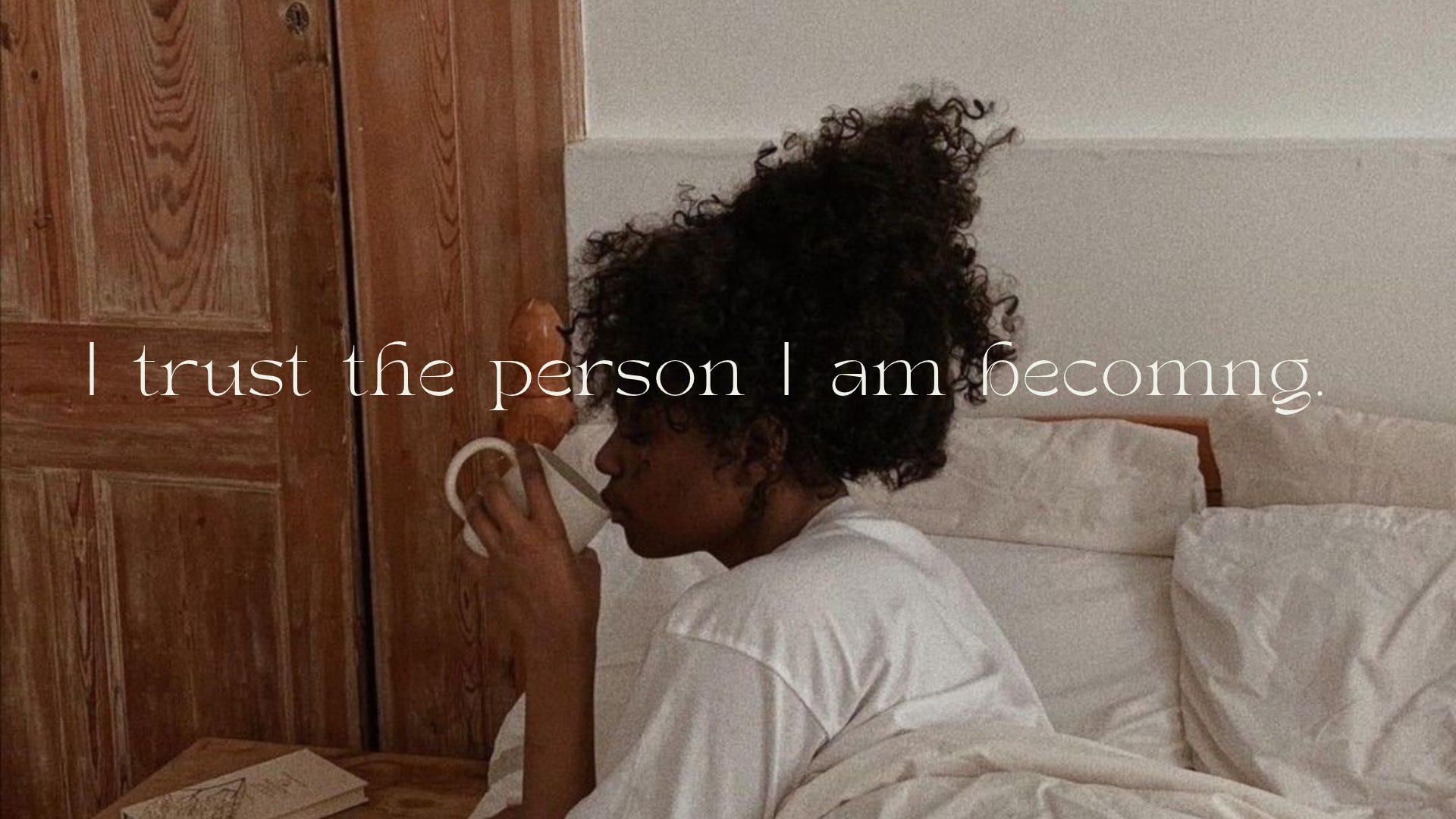
Intuitive eating is also an opportunity to build self-trust. Rather than trying to control your relationship with food, you begin to develop a relationship with your body. You learn to listen rather than dictate, to respond rather than override, and to approach your body’s needs with curiosity rather than suspicion. Relationships cannot be built on control; when control becomes the defining feature, we lose the reciprocity that makes a relationship possible. This is true of our relationships with other people, and it is true of our relationship with ourselves. Your body is not something to dominate into submission. It is something to know, to listen to, and to care for. Self-trust develops as you learn that you can respond to your body’s needs without having to micromanage or punish it.
What inevitability happens with intuitive eating is there is a binge for about a week or two but when your Body realizes it’s true - there is nothing off limits, the taboo repression dissipates. And we can come into contact with our authentic desires.
Perhaps the question isn’t simply how we learn to love our bodies. Perhaps it’s how we learn to inhabit them again. Embodiment is the first step of healing because healing is an inner dialogue with our Body. Embodiment is the first step of healing because it gives you permission to expand, to grow. You taking up more space is good. You are allowed to take up more space.