

How to do affirmations
and using Placebo effect to your advantage

Our inner narrative impacts our beliefs.
Our bodies are always listening to what we say about our Selves.
Would your body be friends with you, given what you say about yourself? We build trust (or destroy it) with what we say about ourselves because our relationship with ourselves is just like any relationship.
How we speak about ourselves can become a self-fulfilling prophecy because we create a confirmation bias to see ourselves through a specific lens. If you’ve been conditioned to see yourself as disorganized, when you forget to respond to an email, then it will trigger an automatic confirmation of evidence supporting self-judgement. When actually, you’re just a human with human limitations and finite executive function.

Affirmations are an important part of healing because we know placebo effect works; if we believe in it, the healing happens. The problem with affirmations is we have to believe them.
The problem with affirmations is fake it till you make it doesn’t work. Fake it till you make it can actually increase imposter syndrome and amplify the feeling that you’re duping everyone around you to believe you’re a good person when secretly you’re terrified of actually being a terrible person whose so manipulative they’ve made everyone around them believe you’re a good person. It happens to more of you than you think.
The problem with affirmations, is we have to have evidence to support the affirmation in order to believe it. If you’ve been told your whole life you’re good for nothing, suddenly saying you’re amazing can actually create more self doubt because it is such an antithesis to your engrained belief system. You actually need to have evidence to support the affirmation - because your brain/body system has so much evidence to the contrary.
You’ve internalized so much falsified evidence that you’re “not good enough” or “too much” or an even more confusing combination of the two. So if you’re going to believe an affirmation, we have to have evidence to counter your lifetime of evidence of lack.


We don’t continue to affirm the negative beliefs engrained in us (that we’re good for nothing, too much or not enough), but we have to start somewhere believable.
Believing you’re worthy is wonderful and necessary but if you don’t yet see yourself as a person, worthiness doesn’t matter yet.
We start at the beginning.
We have to start by humanizing you.
You are a person. You exist.
And then. You deserve good things. You deserve to have your needs met. BECAUSE you are a person.
If we don’t have a foundation of you personhood, then your worthiness isn’t even relevant. Your personhood is what protects you and gives you rights & responsibilities to exist, be worthy of love, etc. This type of chronic objectification impacts [read: suffocates] worthiness because you’re being categorized as inanimate. Objects are inanimate, not sentient and there are no merits of worthiness for my pen, for example.
If you’ve received or participated in chronic objectification, your personhood may be fractured. We have to start with humanizing you again - to bring you back to life from stone.
Affirmations like “the universe is bringing me what I deserve” but you’ve been stuck in believing you deserve to be mistreated (hello, daddy issues), then yes the universe will bring you *exactly what you think you deserve - which just might be a flaming bag of shit on your doorstep. If that’s what you think you deserve.


What we say matters and how specific our words are matter, too. This is something we’ll talk about sometime soon - that our words are spells. As in, spell[ing]. Asking for what you deserve, without specifying what you deserve, is a magick nightmare.
Another obstacle to affirmations actually working is having too many and switching them too often. Sometimes I see people’s affirmation list and there’s 20 affirmations, each lengthy tongue twisting sentences. That just won’t be effective.
Our body requires repetition to build memory - just like doing the same routine at the gym builds muscle memory, for us to build emotional memory, we require repetition. It’s actually more helpful to stay with one simple affirmation than to have a multitude of complex affirmations.
My general rule of thumb is to stay with an affirmation until it feels like old news. Start at the beginning with “I exist” and “I am a person” - these are short, easy to remember and a delicious affirmation for your brain/body to savour. Until “I am a person” feels boring and obvious, that is the only affirmation you use. Once that affirmation feels complete, then and only then do you shift your focus to the next affirmation, like “I am not the problem.”
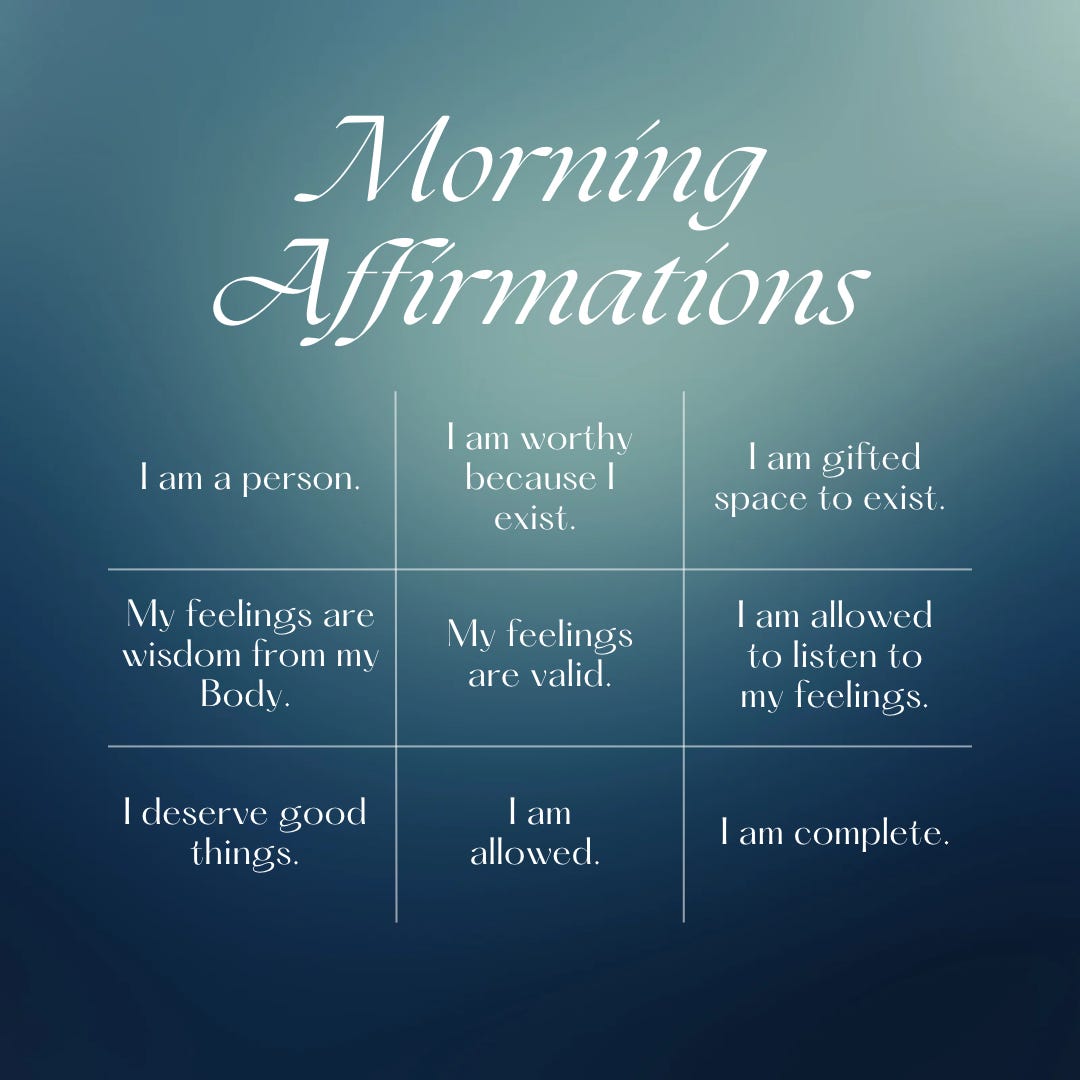
Which affirmation would you choose?
Do you see how these affirmations scaffold on each other? I cannot believe I’m not the problem if I don’t first see myself as a person and I cannot see myself as a person if I don’t recognize I exist. I cannot believe I can trust myself until I believe I’m not the problem.
We often start affirmations at the end outcome we want - but we actually have to build a scaffold to get there. Otherwise, we’re reaching to the top of a 40 storey building with a very rickety ladder held together by spaghetti.
To get to the top of the 40 storey building, we need a real ladder and each affirmation is a rung of the ladder. We start at the beginning.
Now what to do about affirmations.
Write it on your hand
Write it on your mirror
It doesn’t have to be in lipstick, a dry erase marker will do
Leave post-its in your car with your affirmation
As you’re brushing your teeth, repeat your affirmation in your head
When doing dishes, take a deep inhale, say your affirmation then exhale
Record yourself saying your affirmation repeatedly as a voice memo on your phone
Our body responds differently to our own voice so it’s most effective to record it in your voice
Save the images below as your phone background


Alongside saying positive things about ourselves, we also need to reduce self-judgement. It isn’t enough to say nice things about ourself if we’re still berating ourselves at the same time. And it also takes to time to recognize the pattern of self-judgement, let alone intervene.
The first step is to do just that - notice.
When you drop a spatula or forget to respond to an email, instead of allowing a spiral of self-flagellation to run rampant without critique, see if you can just say it with less judgement. Can you say it a bit kinder to yourself?
Perhaps it isn’t a lazy day - perhaps it is more accurately a rest day.
Perhaps you aren’t so stupid - perhaps you made a mistake, or heaven forbid, just forgot.
Humanizing ourselves means working within human limitations. Which means you will forget things. You will make mistakes. And as Ms. Frizzle says, you will get messy.