


The snake has been an important symbol of transformation since my deconstruction from Christianity.
The snake in the Garden of Eden has long been demonized as a deceiver, who (along with the weak will of Eve) was the cause of the downfall of man. The serpent was the temptation. Eve was the one who succumbed. Knowledge became dangerous. Desire became dangerous. Curiosity became dangerous.
In my revisioning of Christian lore and mythological symbols, the snake in the Garden has expanded meaning.
When you have been taught that questioning is dangerous, curiosity becomes an act of rebellion. When you have been taught that obedience is holy, trusting your own knowing becomes an act of liberation. When you have been taught that your desires are sinful, wanting becomes a doorway into the Self.
In my perspective now, the snake is the liberator of humanity, not the downfall.
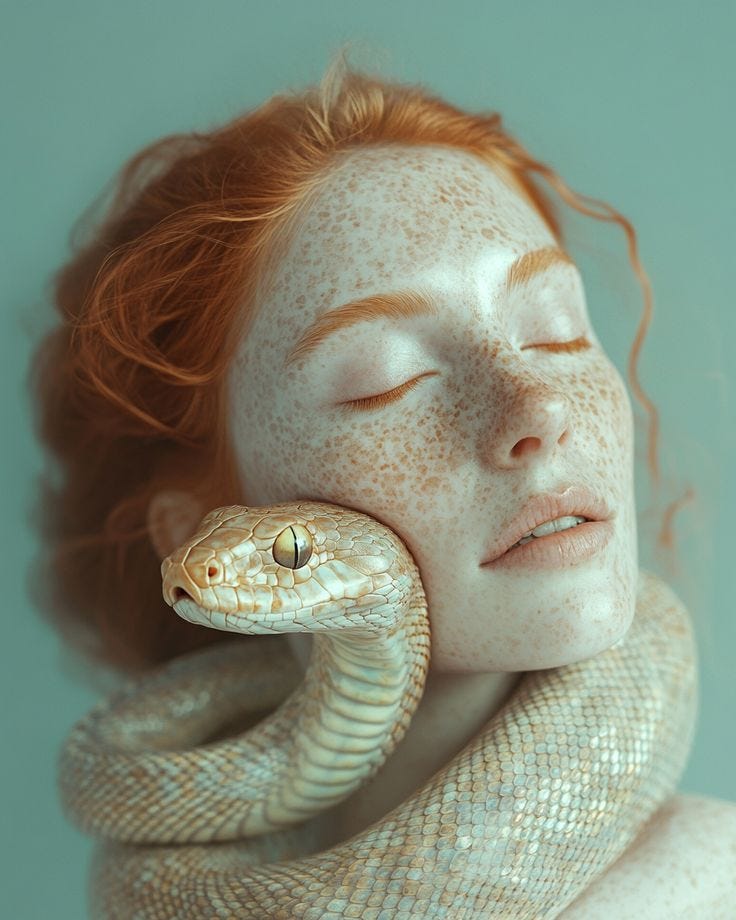
The snake brought enlightenment to humans, just as Prometheus brought fire from the gods, so too did the snake bring Knowledge.
In eating the fruit of the Tree of Knowledge of Good and Evil, Adam and Eve became conscious. They saw the “god” they worshipped for who he actually was - a lion (in the Nag Hammadi texts described as Yaldabaoth) roaming the earth to devour the souls of man.
It was the feminine curiosity, the will to Know, that freed humanity from being enslaved to this abusive deity. And perhaps this is why the story has been so powerful for so many generations. The story is not simply about a woman eating a fruit.
It is about what happens when someone refuses to remain ignorant. It is about what happens when the authority you have been taught to trust tells you that knowledge is dangerous. It is about what happens when you discover that the voice telling you not to question may be the very voice you need to question.
For those of us who have experienced religious trauma, this can be a particularly profound reversal. Many of us were taught to distrust our own internal authority. We were taught that God knew better than we did.
That scripture knew better than we did. That our pastors knew better than we did. That our parents knew better than we did. That our bodies could deceive us. That our desires could deceive us. That our intuition could deceive us. That our sexuality could deceive us. That our questions were evidence of rebellion rather than evidence of consciousness.
And so we learned to look outside of ourselves for the answer to a question that could only ultimately be answered within.
What do I believe?
What do I want?
What feels true?
What feels wrong?
What do I actually experience when I stop telling myself what I am supposed to experience?
This is where the serpent becomes particularly meaningful to me. The serpent is the part of us that says:
But what if?
What if there is more?
What if I am allowed to know?
What if the thing I was taught to fear contains something I need?
What if my desire is not evidence of my depravity, but information?
Eve was not the first wife of Adam - Lilith was.
In later Jewish folklore, Lilith became associated with a woman who refused subservience, and in my own revisioning of these stories, she represents the part of the feminine that refuses to surrender her power in order to be acceptable.
Lilith was not willing to be beneath Adam. She would not submit simply because submission was expected of her. And so she became a demon. There is something profoundly familiar about this to anyone who has experienced religious shame.
The woman who refuses becomes dangerous. The person who questions becomes rebellious. The person who leaves becomes lost. The person who trusts themselves becomes prideful. The person who says “this does not feel right to me” becomes the problem.
Religious systems can turn autonomy into sin. But autonomy is not the same as arrogance. Questioning is not the same as rebellion. Desire is not the same as depravity. And leaving is not necessarily a failure of faith. Sometimes leaving is the first time we have ever listened to ourselves.
In the Gnostic traditions that have become meaningful to me, Sophia represents divine Wisdom - not something handed down from above, but something that emanates, something that is already present.
And Eve’s name means Life. I love this symbolism. Life and Wisdom are not enemies. Curiosity and spirituality are not enemies. Desire and consciousness are not enemies. The feminine does not need to be rescued from her own knowing. The serpent in the Garden can therefore become something entirely different.
Not the embodiment of evil. Not the tempter. Not the enemy of God. But the invitation to Know. The serpent becomes the threshold between innocence and consciousness. Between obedience and discernment. Between external authority and Inner authority. Between being told what is true and discovering what is true for yourself.
Serpents in other traditions have represented transformation, healing, rebirth and enlightenment too - including the rising of kundalini.
The snake sheds its skin. It does not become a different creature. It becomes more fully itself.
And perhaps that is what religious deconstruction can be. Not becoming someone else. Not abandoning spirituality. Not replacing one rigid belief system with another.
But shedding the identities, fears, rules and beliefs that were wrapped around the Self until we can finally feel the Self underneath.
This is why the serpent has become such a powerful symbol for me.
It represents the part of us that refuses to stop knowing. The part that remains curious. The part that asks questions. The part that notices when something feels wrong. The part that follows desire into the unknown. Our desires bring Knowledge.
Not because every desire must be acted upon, but because every desire contains information.
What do I want?
Why do I want it?
What does wanting this reveal about me?
What have I been taught to believe about this desire?
Whose voice tells me I shouldn’t want it?
What happens when I stop treating that voice as God?
Trusting our desires does not mean blindly following every impulse. It means becoming curious about them. It means allowing ourselves to know ourselves.
And for those of us who were taught that self-knowledge was dangerous, that may be one of the most radical forms of healing there is. May you find what you need to trust in your Self. May you become curious about the parts of you that were taught to be ashamed. May you question the voices that told you that you could not know.
And may you, like Eve, eat the fruit. Not because you are disobedient. But because you are ready to Know.